Costa Rica covers a tiny slice of the planet, yet it holds around five percent of the world’s known species. That density means you don’t have to trek for days to see wildlife. Sloths hang above hotel pools, monkeys cross the road, and toucans call from the trees at breakfast.
This guide focuses on five exotic animals you are very likely to encounter on a trip to Costa Rica: the sloth, the monkey, the toucan, the red-eyed tree frog and the scarlet macaw. For each one you will find what it looks like, exactly where and when to see it, how to spot it, and how to watch it responsibly. After that, you will find more remarkable animals worth looking for, plus region and season guides to help you see as many as possible.
Key Takeaways
- The five animals you are most likely to encounter are sloths, monkeys, toucans, red-eyed tree frogs and scarlet macaws.
- Location decides what you see. Manuel Antonio is best for sloths and monkeys, the Caribbean lowlands for toucans and frogs, and Carara and the Osa Peninsula for scarlet macaws.
- Go early, go late, and go at night. Most animals are active in the cool hours, and frogs only appear after dark.
- A naturalist guide multiplies your sightings. Guides with spotting scopes find camouflaged sloths, frogs and snakes you would walk straight past.
- Look, but never touch or feed. Wild animals in Costa Rica are protected, and feeding or handling them causes real harm.
Why Costa Rica Has So Many Exotic Animals
Costa Rica’s wildlife is so rich because of where it sits and how it is shaped.
- A land bridge between two continents. Costa Rica lies on the narrow strip of land that connects North and South America. When the two continents joined millions of years ago, animals moved in both directions, so species from both continents meet here.
- Two coasts and a mountain spine. The Pacific and Caribbean coasts have different climates, and volcanic mountain ranges run down the middle of the country. In a few hours you can travel from dry forest to rainforest to misty cloud forest, each with its own animals.
- Many habitats packed close together. Mangroves, wetlands, beaches, lowland rainforest, cloud forest and high-altitude páramo all fit within a small country, which means a huge variety of species in a small area.
- Serious protection. Roughly a quarter of Costa Rica’s land is protected in national parks, reserves and refuges, which gives wildlife room to thrive and makes animals easier for visitors to see.
The result is a country where sloths, monkeys, toucans, tree frogs and macaws are not rare sightings but part of everyday life.
The 5 Exotic Animals at a Glance
| Animal | Where you are most likely to see it | Best time of day | How easy to spot |
|---|---|---|---|
| Sloths | Manuel Antonio, Cahuita, Puerto Viejo, Tortuguero, La Fortuna | Morning (three-toed); night (two-toed) | Easy with a guide, tricky alone |
| Monkeys | Nearly every forested area; all four species in Corcovado | Early morning and late afternoon | Very easy |
| Toucans | Tortuguero, Sarapiquí, Arenal, the Caribbean coast | Early morning | Easy, especially by call |
| Red-eyed tree frog | Tortuguero, Sarapiquí, Arenal, the Caribbean lowlands | Night, especially after rain | Easy on a guided night walk |
| Scarlet macaw | Carara, Tárcoles, the Osa Peninsula | Early morning and late afternoon | Easy in the right region |
1. Sloths
No animal says Costa Rica like the sloth. With its slow movements, shaggy coat and gentle expression, it is the animal most visitors want to see, and the good news is that you almost certainly will.
Two species to look for
Costa Rica has two sloth species. The brown-throated three-toed sloth is smaller and grayish-brown, with a dark mask across its eyes that makes it look like it is always smiling. It is active during the day, which makes it the easier species to see. The Hoffmann’s two-toed sloth is larger and paler, with a pig-like snout and two long claws on each front foot. It is mostly active at night.
Where you will encounter them
Three-toed sloths are common in Manuel Antonio, Cahuita, Puerto Viejo, Tortuguero and the La Fortuna area near Arenal. At higher, cooler elevations such as Monteverde, the two-toed sloth is usually the only species, and a night walk gives you the best chance of seeing one on the move.
How to spot one
Sloths look like a clump of leaves, a termite nest or a ball of fur wedged in a fork of a branch. Scan the canopy slowly, paying attention to cecropia trees, whose large, hand-shaped leaves are a favorite food. Sloths are often easier to see on a sunny morning after rain, when they climb higher to warm up. A guide with a spotting scope can turn a vague shape into a clear view of a face, claws and sometimes a baby clinging to its mother’s chest.
Fun facts
Sloths move so little that algae grows in their fur, giving them a greenish tint that helps them blend into the leaves. They come down to the ground only about once a week to go to the bathroom, which is the most dangerous moment of their routine. Surprisingly, they are strong swimmers. The three-toed sloth also has extra neck vertebrae, so it can turn its head much farther than most mammals.
Best time to see them
Sloths can be seen year-round. For three-toed sloths, mid-morning on a sunny day is ideal, especially after a rainy night, when they climb into exposed branches to warm up. Two-toed sloths are best seen on evening walks, when they start moving between trees. In the green season, the forest is denser, so a guide’s scope becomes even more useful.
Watch them responsibly
Never touch or hold a sloth, and avoid any business that offers photos with one. Handling causes sloths serious stress. If you want to see sloths up close, choose a rescue center that rehabilitates and releases animals and does not allow contact.
2. Monkeys
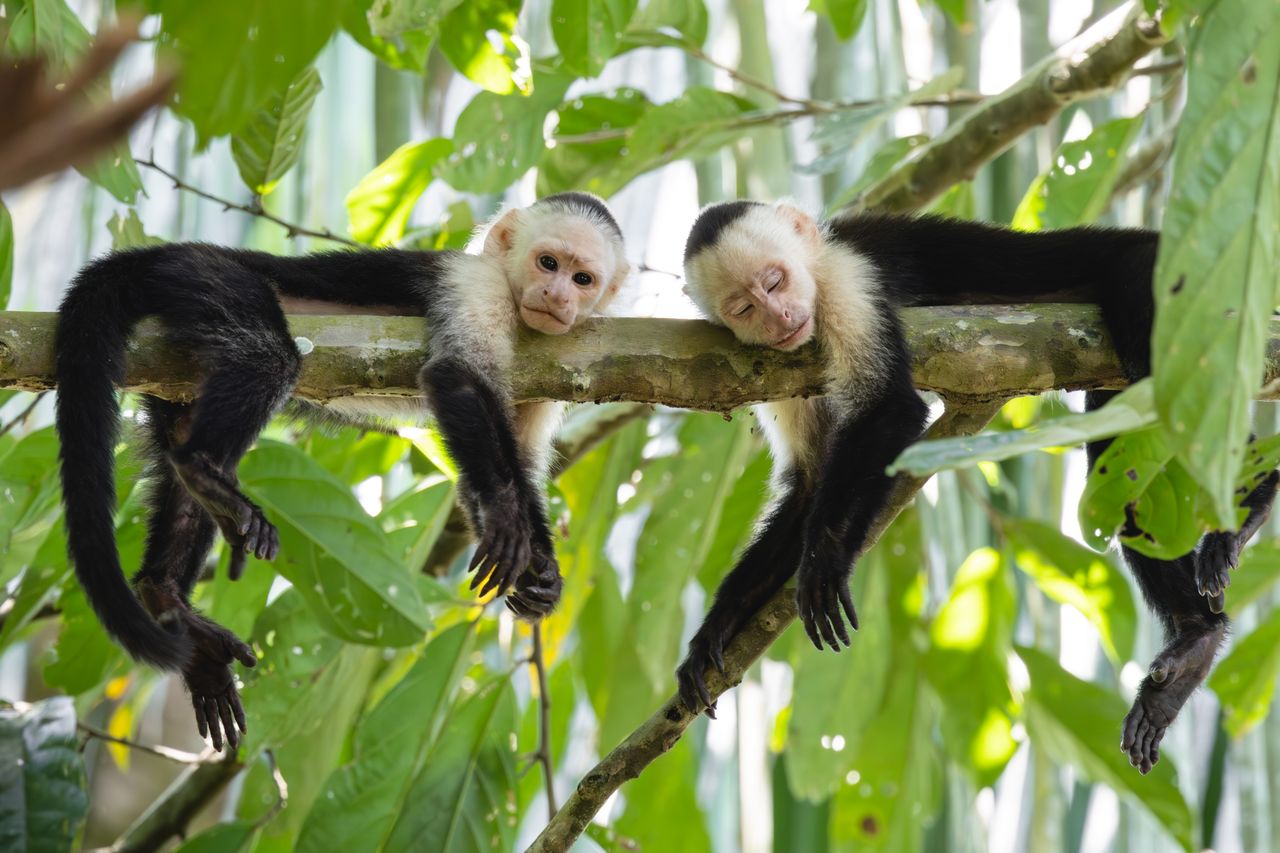
You will hear Costa Rica’s monkeys long before you see them, and you will almost certainly see them. Costa Rica has four monkey species, and each one has its own personality.
The four species
- Mantled howler monkey: large, dark and slow-moving, with a deep roar that is one of the loudest calls of any land animal. Howlers are found in almost every forest, including the dry forests of Guanacaste.
- White-faced capuchin: small, clever and endlessly busy, with a white face and shoulders. Capuchins use tools and are famous for raiding unattended bags in Manuel Antonio.
- Central American squirrel monkey: the smallest and rarest, golden-orange with a black-and-white face. It lives only on the central and southern Pacific coast of Costa Rica and a small part of Panama.
- Geoffroy’s spider monkey: the acrobat of the canopy, with long limbs and a tail that grips branches like a fifth hand. It is endangered and needs large areas of healthy forest.
Where you will encounter them
Howlers and capuchins are widespread, from Guanacaste and Palo Verde to Arenal, Manuel Antonio, Cahuita and Tortuguero. Squirrel monkeys are found mainly in Manuel Antonio and the Osa Peninsula. Spider monkeys are most reliable in Corcovado, along the canals of Tortuguero and in Santa Rosa. Corcovado National Park on the Osa Peninsula is one of the few places where you can see all four species.
How to spot them
Listen first. A howler’s roar at dawn tells you where the troop is, and moving branches and falling fruit give away capuchins and spider monkeys. Squirrel monkeys move in fast, chattering troops, often along forest edges near beaches in the early morning.
Best time to see them
Monkeys are active year-round. Howlers call loudest at dawn and dusk, and capuchins and squirrel monkeys are busiest in the early morning and late afternoon, when they forage. During the hottest part of the day, most troops rest in the shade, so midday walks tend to be quiet. In the dry season, monkeys often gather near rivers and fruiting trees, which makes them easier to find.
Fun facts
Howler monkeys spend much of the day resting because their leaf diet provides little energy. Capuchins rub certain plants and insects into their fur, which scientists believe may repel insects. Spider monkeys have only a tiny bump where most primates have a thumb, which helps them swing quickly from branch to branch.
Watch them responsibly
Never feed monkeys. Human food makes them sick, and monkeys that learn to take food from people become aggressive. Zip your bags, keep snacks out of sight, and don’t stand directly under a troop of howlers.
3. Toucans
With an enormous, colorful bill on a compact black body, the toucan looks almost too tropical to be real. In Costa Rica it is a common sight, and its call is part of the soundtrack of the lowland rainforest.
The species to look for
Costa Rica has six toucan species. The keel-billed toucan is the famous one, with a bill striped in green, blue, orange and red. Its call is a surprising, frog-like croak. The larger yellow-throated toucan, also called the chestnut-mandibled toucan, has a two-toned bill and a loud, yelping call. Smaller relatives include the collared aracari, the fiery-billed aracari on the southern Pacific coast, and the northern emerald toucanet in the highlands.
Where you will encounter them
Toucans are easiest to see in the Caribbean lowlands, including Tortuguero, Sarapiquí, Cahuita and Puerto Viejo, and around Arenal. You will also find them in forests along the Pacific coast, and many lodges with fruiting trees or fruit feeders get daily visits.
How to spot them
Follow the calls. Toucans often travel in small groups and move between fruiting trees, so once you hear them, watch the tops of nearby trees. Early morning is best, when they are actively feeding and calling.
Best time to see them
Toucans are resident birds, so you can see them in any month. The first two hours after sunrise are the most reliable, when they move between fruiting trees and call to each other. Late afternoon is a good second chance. In the drier months, fruiting trees near rivers and lodge gardens become magnets for toucans and aracaris.
Fun facts
A toucan’s bill looks heavy, but it is mostly hollow, made of a light framework of bone covered in keratin, the same material as human fingernails. Researchers have found the bill also helps the bird release body heat. Toucans eat mostly fruit, but they also take insects, small lizards and sometimes the eggs of other birds.
Watch them responsibly
Enjoy toucans in the wild rather than in places that keep them as pets or photo props. Wild toucans are protected in Costa Rica.
4. Red-Eyed Tree Frog
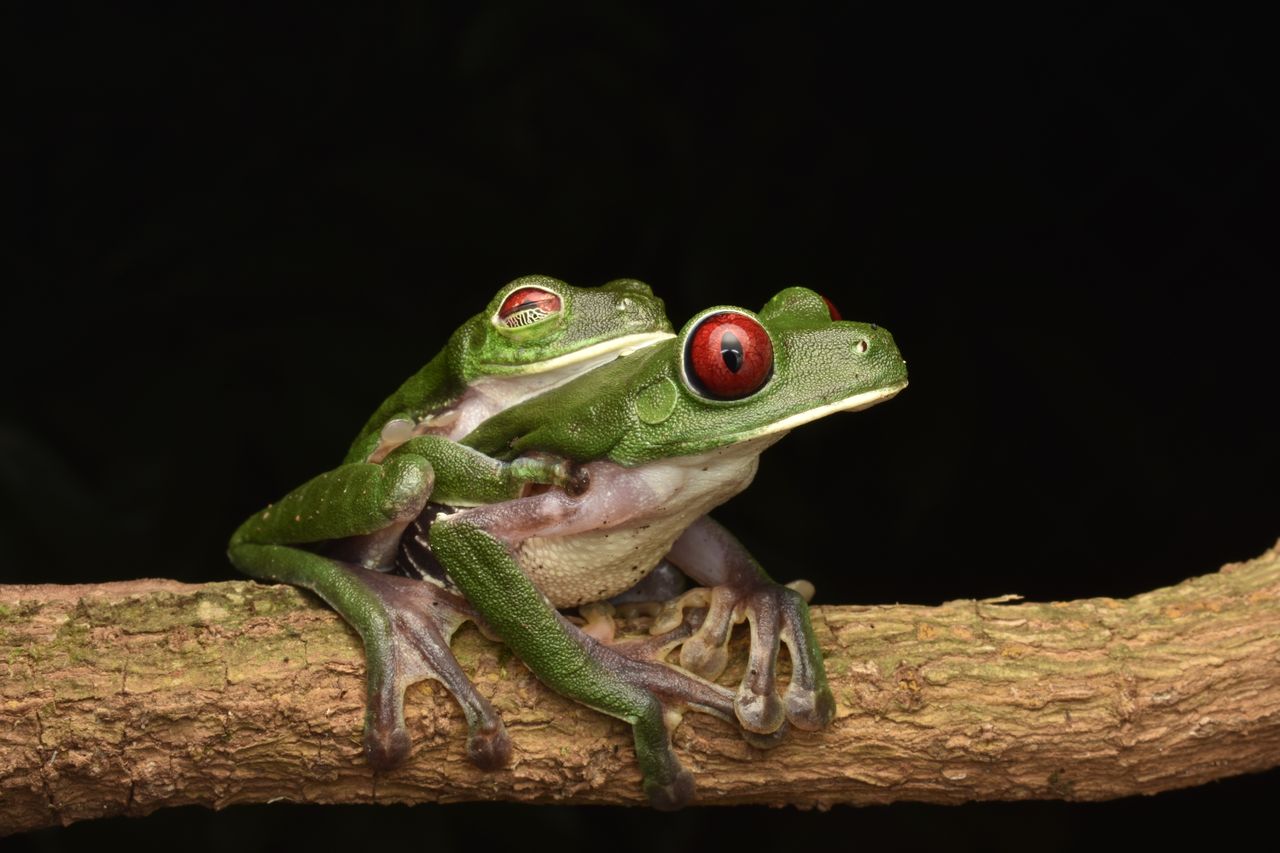
The red-eyed tree frog is Costa Rica’s most photographed amphibian and one of the most recognizable animals in the world. Its bright colors and huge red eyes have made it a symbol of the rainforest.
What it looks like
The frog is lime green with blue and yellow stripes along its sides, bright orange feet, and large, vivid red eyes. By day it sleeps flattened against the underside of a leaf, with its colorful legs tucked in and its eyes covered by a green eyelid, so it looks like nothing more than a small bump on a leaf.
Where you will encounter it
Red-eyed tree frogs live in the humid lowland forests of both coasts. Good places include Tortuguero, Sarapiquí, Arenal, Cahuita, Puerto Viejo and the Osa Peninsula. Many lodges have ponds or gardens where the frogs gather to breed.
How to spot one
Take a guided night walk. Red-eyed tree frogs are nocturnal and are most active on warm, humid nights, especially after rain. Guides use flashlights to scan leaves near ponds and streams, where males call to attract females. The rainy months are breeding season, which is when you are most likely to see them in numbers.
Best time to see them
Red-eyed tree frogs are easiest to see during the green season, from about May to November, when rain fills breeding ponds and males call every night. Warm nights right after a rain shower are best. In the dry season they are still around but quieter and more spread out, so a guide who knows the local ponds is especially helpful.
Fun facts
When a predator approaches, the frog suddenly opens its red eyes and flashes its bright sides and feet. Scientists call this startle coloration, and it can confuse a predator long enough for the frog to leap away. Females lay their eggs on leaves that hang over water, and when the tadpoles hatch they drop straight into the pond below. Researchers have even found that the eggs can hatch early if they sense the vibrations of an attacking snake.
Watch it responsibly
Don’t touch frogs. Their skin is extremely sensitive, and oils, sunscreen and insect repellent on your hands can harm them. Ask your guide to use a red light or a dimmed flashlight and keep photo sessions short.
5. Scarlet Macaw
A pair of scarlet macaws flying overhead, glowing red, yellow and blue against the sky and calling loudly, is one of the great sights of the Pacific coast. Few animals feel more exotic.
What it looks like
The scarlet macaw is a large parrot with bright red feathers, yellow and blue wings, a long pointed tail, and a pale, bare face. Its powerful bill can crack hard nuts with ease. Macaws are social and usually travel in pairs or small flocks.
Where you will encounter it
Scarlet macaws live mainly on the Pacific side of Costa Rica. The most reliable places are Carara National Park and the nearby Tárcoles area, and the Osa Peninsula, including Corcovado, Drake Bay and the area around Puerto Jiménez. On the Osa Peninsula, they often gather in the beach almond trees right along the shore.
How to spot one
Listen for loud, harsh squawks, then look up. Macaws are most visible in the early morning and late afternoon, when they fly between their feeding areas and roosts. In Carara, they are often seen flying over the river and the forest edge.
Best time to see them
Scarlet macaws live in Costa Rica year-round. They are most visible in the early morning and late afternoon flights between feeding areas and roosts. In the dry season, many trees lose their leaves on the Pacific side, which makes macaws feeding in the branches easier to see. On the Osa Peninsula, beach almond trees often attract them for much of the year.
Fun facts
Scarlet macaws form long-term pairs, and you will often see two flying wing to wing. They can live for decades. Once in steep decline in Costa Rica because of habitat loss and the pet trade, they have made a strong comeback thanks to protection and conservation programs.
A rarer relative
On the Caribbean side, look for the great green macaw, an endangered species that depends on the almendro tree for nesting and food. The northern Caribbean lowlands around Sarapiquí and the Maquenque Wildlife Refuge are the best places to try.
More Exotic Animals You Might Encounter in Costa Rica
The five animals above are the ones you are most likely to see, but Costa Rica has many more. With the right region, season and a little luck, you might also encounter these:
Resplendent Quetzal
The resplendent quetzal is one of the most beautiful birds in the Americas, with emerald feathers, a crimson chest and tail streamers that can be longer than its body. It was sacred to the ancient Maya and Aztecs. Look for it in the cloud forests of San Gerardo de Dota, Los Quetzales National Park and Monteverde, especially from about February to July during breeding season.
Hummingbirds
Costa Rica has more than 50 hummingbird species, from the large violet sabrewing to the tiny scintillant hummingbird. Feeder gardens in Monteverde and the highlands put dozens of them inches from your face.
White-Nosed Coati
The coati, or pizote, is a raccoon relative with a long, flexible snout and a ringed tail held straight up. Bands of females and young sweep the forest floor for insects and fruit. You will often see them around Arenal, Monteverde and Corcovado.
Kinkajou
The kinkajou is a big-eyed, golden-furred tree dweller with a gripping tail. It is related to raccoons and is sometimes called the honey bear because of its long tongue and love of nectar. It is strictly nocturnal, so look for it on night walks.
Northern Tamandua
This tree-climbing anteater has a long snout, a sticky tongue and powerful claws for opening ant and termite nests. Its tan body and dark vest-like marking make it easy to recognize. It turns up in forests across the country.
Baird’s Tapir
The tapir is the largest land mammal in Central America, a shy relative of horses and rhinos with a short, flexible snout. It is endangered, and Corcovado National Park, especially around Sirena Ranger Station, offers the best chance to see one, usually near water at dawn or dusk.
Wild Cats
Costa Rica has six wild cats: jaguar, puma, ocelot, margay, oncilla and jaguarundi. All are secretive, and most visitors see only tracks. The ocelot is the most often seen, usually at night, while jaguars are known to patrol Tortuguero’s beaches during turtle nesting season.
Honduran White Bat
These tiny, fluffy white bats cut the veins of a heliconia leaf so it folds into a tent, then roost in a small cluster underneath. Look for them in the Caribbean lowlands, including Sarapiquí, Tortuguero, Cahuita and Puerto Viejo.
Basilisk Lizard
The basilisk can sprint across the surface of water on its hind legs, which earned it the nickname “Jesus Christ lizard.” Watch for it along rivers and streams in Tortuguero, Arenal and Manuel Antonio.
American Crocodile
Large American crocodiles bask on the banks of the Tárcoles River, and the bridge over the river is a safe place to see them from above. Never swim in river mouths or estuaries.
Eyelash Viper
The eyelash viper is a small pit viper named for the raised scales above its eyes, and some are a striking golden yellow. It is venomous but not aggressive. Let a guide point it out, and admire it from a distance.
Poison Dart Frogs
These tiny, jewel-bright frogs get their toxins from the insects they eat in the wild. Look for the red, blue-legged strawberry poison dart frog in the southern Caribbean and the green-and-black poison dart frog in lowland forests. They are harmless unless handled.
Glass Frogs
Glass frogs have see-through bellies, so you can see their hearts and organs from below. They sit on leaves above streams at night in places such as Monteverde, Arenal and Bijagua.
Sea Turtles
Green, leatherback, hawksbill, loggerhead and olive ridley turtles all nest in Costa Rica. Green turtles nest at Tortuguero from about July to October, and olive ridleys come ashore in huge numbers at Ostional. Night visits to nesting beaches require a licensed guide.
Humpback Whales
Humpbacks from both hemispheres visit Costa Rica’s Pacific coast, giving it one of the longest whale seasons in the world, from about July to October and December to March. Marino Ballena National Park near Uvita is the best-known place to see them.
Blue Morpho Butterfly
The blue morpho flashes electric blue in flight, then disappears when it lands and shows the brown undersides of its wings. The blue comes from tiny structures on the wing that reflect light rather than from pigment.
Where to See Exotic Animals in Costa Rica
Each region of Costa Rica has its own wildlife. Combining two or three regions with different habitats is the best way to see all five animals in this guide.
| Region | Habitat | Animals from this guide | Also look for |
|---|---|---|---|
| Manuel Antonio | Rainforest meets beach | Sloths, capuchins, squirrel monkeys, howlers | Iguanas, coatis |
| Osa Peninsula and Corcovado | Lowland rainforest and coast | All four monkeys, scarlet macaws, sloths, red-eyed tree frogs | Tapirs, wild cats, whales |
| Tortuguero | Caribbean canals and beaches | Sloths, toucans, red-eyed tree frogs, spider monkeys | Sea turtles, caimans |
| Arenal and La Fortuna | Rainforest around a volcano | Sloths, toucans, red-eyed tree frogs, howlers | Coatis, basilisks |
| Southern Caribbean (Cahuita, Puerto Viejo) | Coastal rainforest | Sloths, toucans, howlers, red-eyed tree frogs | Poison dart frogs, white bats |
| Sarapiquí | Lowland rainforest | Toucans, red-eyed tree frogs, great green macaws | Bats, poison dart frogs |
| Carara and Tárcoles | Transition forest and river | Scarlet macaws, capuchins | Crocodiles |
| Monteverde | Cloud forest | Two-toed sloths, howlers | Quetzals, hummingbirds, glass frogs |
When to Go
Wildlife is visible all year in Costa Rica, but conditions change with the seasons.
| Season | When | What it means for wildlife |
|---|---|---|
| Dry season | December to April | Sunny trails and easier spotting on the Pacific side; parks are busiest |
| Green season | May to November | Lush forests, fewer people, afternoon rain; peak frog activity |
| Caribbean drier months | Often September and October | A good time for Tortuguero and the southern Caribbean |
Whatever month you travel, plan wildlife walks for early morning and late afternoon, and include at least one guided night walk.
How to See All Five Animals on One Trip
Because each of the five animals favors different habitats, the easiest way to see all of them is to combine a Caribbean region with a Pacific one.
- Caribbean side (Tortuguero, Sarapiquí, Cahuita or Puerto Viejo): toucans, red-eyed tree frogs, sloths, howler monkeys and, on the canals of Tortuguero, spider monkeys.
- Arenal and La Fortuna: a good link between the two coasts, with sloths, toucans, howlers and red-eyed tree frogs on night walks.
- Central or southern Pacific (Carara, Manuel Antonio or the Osa Peninsula): scarlet macaws, capuchins, squirrel monkeys and more sloths.
A route that includes one region from each coast gives you a strong chance of encountering all five animals, along with many of the others in this guide.
What to Pack for Wildlife Watching
- Binoculars, even a compact pair
- A camera or phone with good zoom
- A headlamp or flashlight with a red-light setting for night walks
- Closed-toe hiking shoes
- A lightweight rain jacket, even in the dry season
- Quick-dry clothes in neutral greens and browns
- Insect repellent and reef-safe sunscreen
Tips for Spotting Wildlife in Costa Rica
- Hire a certified naturalist guide. Guides know where animals are feeding and carry spotting scopes. This is the single biggest factor in how much you see.
- Start early. Arrive at parks when they open, before the heat and the crowds.
- Move slowly and quietly. Stop often, listen, and scan the canopy and the ground.
- Bring binoculars. Even a compact pair makes a big difference for birds and sloths.
- Do a night walk. Many animals, including frogs, kinkajous and two-toed sloths, only come out after dark.
- Wear closed-toe shoes and carry a light. It protects you on trails, especially at night.
How to Watch Wildlife Responsibly
- Never touch, hold or feed wild animals. It harms their health and changes their behavior.
- Keep your distance. Use a zoom lens or binoculars instead of moving closer.
- Avoid flash and bright lights on sleeping animals and nesting turtles.
- Choose ethical tours and sanctuaries. Avoid any business that baits animals or offers photos holding wildlife.
- Stay on marked trails to protect habitats and avoid snakes.
Frequently Asked Questions About Exotic Animals in Costa Rica
What exotic animals can you see in Costa Rica?
The exotic animals visitors most often encounter are sloths, monkeys, toucans, red-eyed tree frogs and scarlet macaws. With the right region and timing you may also see resplendent quetzals, coatis, tapirs, poison dart frogs, sea turtles and humpback whales.
Where is the best place to see sloths in Costa Rica?
Manuel Antonio, Cahuita, Puerto Viejo, Tortuguero and the La Fortuna area near Arenal are reliable places to see sloths in the wild. A guide with a spotting scope makes a big difference, because sloths blend into the canopy.
How many types of monkeys are in Costa Rica?
Costa Rica has four monkey species: the mantled howler, the white-faced capuchin, the Central American squirrel monkey and Geoffroy’s spider monkey. Corcovado National Park on the Osa Peninsula is one of the few places where you can see all four.
Where can you see toucans in Costa Rica?
Toucans are easiest to see in the Caribbean lowlands, including Tortuguero, Sarapiquí, Cahuita and Puerto Viejo, and around Arenal. Early morning is the best time, when they are feeding and calling.
Where can you see scarlet macaws in Costa Rica?
The most reliable places are Carara National Park and the Tárcoles area on the central Pacific coast, and the Osa Peninsula, including Corcovado and Drake Bay. Look for them in the early morning and late afternoon.
What is the national animal of Costa Rica?
The white-tailed deer is Costa Rica’s national mammal, and the clay-colored thrush, known locally as the yigüirro, is the national bird.
Are there dangerous animals in Costa Rica?
A few. American crocodiles live in rivers and estuaries, and venomous snakes such as the fer-de-lance and eyelash viper live in forests. Serious incidents with visitors are rare. Stay on trails, wear closed shoes, use a flashlight at night, never swim in river mouths, and never touch wildlife.
When is the best time to see wildlife in Costa Rica?
Wildlife is visible year-round. The dry season from December to April makes Pacific-side trails easiest, while the green season from May to November brings fewer crowds and the most frog activity. Early morning, late afternoon and night walks give the most sightings.
Do you need a guide to see wildlife in Costa Rica?
You can see plenty on your own, but a certified naturalist guide will show you far more. Guides know where animals are feeding, carry spotting scopes and can find camouflaged sloths, snakes and frogs you would walk past. Night walks and turtle nesting tours require a guide.
Final Thoughts
Sloths, monkeys, toucans, red-eyed tree frogs and scarlet macaws are the five exotic animals you are most likely to encounter in Costa Rica, and seeing them in the wild is unforgettable. Plan your days around the early mornings, spend at least one night walking the rainforest with a guide, and visit more than one region. Above all, watch from a respectful distance, so these animals stay wild for the travelers who come after you.