Costa Rica is small, but it packs in an astonishing range of places. In a single day you can drive from sunny, dry beaches to misty cloud forest, or from a smoking volcano to a jungle coast where the roads run out. That variety is the country’s greatest strength, and it is also why choosing where to go can feel overwhelming.
The secret is that you don’t need to see all of Costa Rica. You need to find the regions that match the trip you want. This guide breaks the country into its main travel regions, explains what each one is like, who it suits and who it doesn’t, and then helps you match a region to your travel style, your season and the length of your trip.
Key Takeaways
- Beach and sunshine: Guanacaste and the Nicoya Peninsula are the driest, sunniest regions, with the easiest beach access from Liberia airport.
- Volcanoes, adventure and cloud forest: Arenal and Monteverde are the classic inland pairing and suit almost every traveler.
- Wildlife and beach together: the Central Pacific around Manuel Antonio balances both and is easy to reach from San José.
- Wild and remote: the Osa Peninsula and Tortuguero reward travelers willing to trade convenience for nature.
- Culture and a slower pace: the southern Caribbean coast offers Afro-Caribbean food and music, rainforest and quiet beaches.
- Most first trips combine two or three regions, usually one inland region and one coast.
Find Your Match: A Quick Quiz
Answer these five questions and keep track of which letter you choose most often.
- Your ideal morning on vacation is:
- A swim in calm, warm water before breakfast
- A hike to a waterfall or a ride on a zipline
- Watching monkeys and macaws from a jungle lodge deck
- Strong coffee, fresh fruit and nowhere to be
- A rainforest walk followed by an afternoon at the beach
- Which matters most to you?
- Reliable sunshine
- Variety of activities
- Untouched nature and few people
- Local culture and food
- A balance of everything
- How do you feel about long or rough journeys?
- I’d rather keep travel time short
- A few hours of scenic driving is fine
- Small planes, boats and bumpy roads are part of the adventure
- Happy to travel if the destination is relaxed
- Moderate travel is fine if the payoff is good
- Where would you rather stay?
- A beach resort with a pool
- A lodge with volcano or forest views and hot springs nearby
- A remote eco-lodge in the rainforest
- A small guesthouse or boutique hotel near the beach
- A hillside hotel overlooking both forest and ocean
- Who are you traveling with?
- Family with young kids, or a group that wants easy logistics
- Active friends or older kids
- A partner who loves nature as much as you do
- Solo, or a partner who likes to slow down
- Anyone; we want a bit of everything
Your results
- Mostly A: Guanacaste or the Nicoya Peninsula. You want sun, beaches and easy logistics.
- Mostly B: Arenal and Monteverde. You want adventure, volcano views and cloud forest.
- Mostly C: The Osa Peninsula or Tortuguero. You want wild nature and are happy to go remote.
- Mostly D: The southern Caribbean coast. You want culture, food and an unhurried pace.
- Mostly E: The Central or South Pacific coast. You want rainforest wildlife and beaches in one place.
If your answers were split, that’s a sign you’ll enjoy combining two regions, which is how most visitors see Costa Rica anyway.
Costa Rica’s Regions at a Glance
| Region | Vibe | Best for | Nearest airport |
|---|---|---|---|
| Guanacaste (North Pacific) | Sunny, dry, resort and beach towns | Beaches, families, all-inclusive stays, short trips | Liberia (LIR) |
| Nicoya Peninsula | Laid-back surf and wellness towns | Surfers, yoga and wellness, couples | Liberia (LIR) or San José (SJO) |
| Central Pacific | Rainforest meets beach, easy to reach | First-timers, families, wildlife plus beach | San José (SJO) |
| South Pacific (Costa Ballena) | Quieter coast, waterfalls, whales | Whale watching, relaxed beaches | San José (SJO) |
| Osa Peninsula | Remote, wild, primary rainforest | Serious wildlife lovers, adventurous couples | San José (SJO) plus a domestic flight |
| Arenal and the Northern Plains | Volcano, hot springs, adventure | Active travelers, families, first-timers | San José (SJO) or Liberia (LIR) |
| Monteverde | Cool, misty cloud forest | Nature lovers, birders, hanging bridges | San José (SJO) or Liberia (LIR) |
| Tortuguero (North Caribbean) | Canals, no roads, turtles | Turtle season, boat-based wildlife | San José (SJO) plus boat or small plane |
| South Caribbean | Afro-Caribbean culture, reggae, rainforest | Food lovers, relaxed travelers, culture | San José (SJO) |
| Central Valley and San José | Capital, coffee, volcanoes | Culture, coffee, short stopovers | San José (SJO) |
| Southern Highlands | Mountains, cool air, quetzals | Birders, hikers, a cool-weather break | San José (SJO) |
The Regions of Costa Rica, Explained
Guanacaste (North Pacific)
Guanacaste is Costa Rica’s sunniest and driest region, a land of golden beaches, dry tropical forest and cattle ranches with a strong sabanero, or cowboy, culture. It has the country’s largest concentration of beach resorts, especially around the Papagayo Peninsula, along with lively beach towns such as Tamarindo and the white sand of Playa Conchal.
Best for: beach lovers, families who want easy logistics, all-inclusive resort stays and short trips.
Highlights: Rincón de la Vieja National Park with its hot springs and bubbling mud pots, river safaris and birdwatching in Palo Verde, surfing in Tamarindo, sunset sailing, and snorkeling in calm bays.
Getting there: Liberia International Airport (LIR) puts many beaches within an hour’s drive, which makes Guanacaste the easiest region to reach for a short stay.
Weather: the dry season (December to April) is reliably sunny and hot, and the landscape turns golden and brown. In the green season, the hills turn lush and rain usually arrives in the afternoon.
Maybe not for you if: you want dense rainforest wildlife right outside your door. Guanacaste has howler monkeys and coatis, but the jungle experience is stronger elsewhere.
Nicoya Peninsula
The Nicoya Peninsula is Guanacaste’s more laid-back neighbor, with surf towns, yoga retreats and long, empty beaches. Santa Teresa and Malpaís attract surfers and a creative crowd, Nosara is known for wellness and surfing, and Montezuma has a bohemian feel. Nicoya is also one of the world’s Blue Zones, places where people tend to live unusually long lives.
Best for: surfers, yoga and wellness travelers, couples, and anyone who wants a slower, barefoot pace.
Highlights: surf lessons, the Cabo Blanco Nature Reserve, Montezuma waterfall, and the olive ridley turtle arribadas at Ostional, when thousands of turtles nest over a few nights.
Getting there: northern Nicoya is reached from Liberia. The southern tip is reached by road or by ferry across the Gulf of Nicoya from Puntarenas. Some roads are still unpaved and dusty, and small planes serve several towns.
Maybe not for you if: you want polished resorts and smooth roads. Much of Nicoya’s charm comes from its rustic edges.
Central Pacific
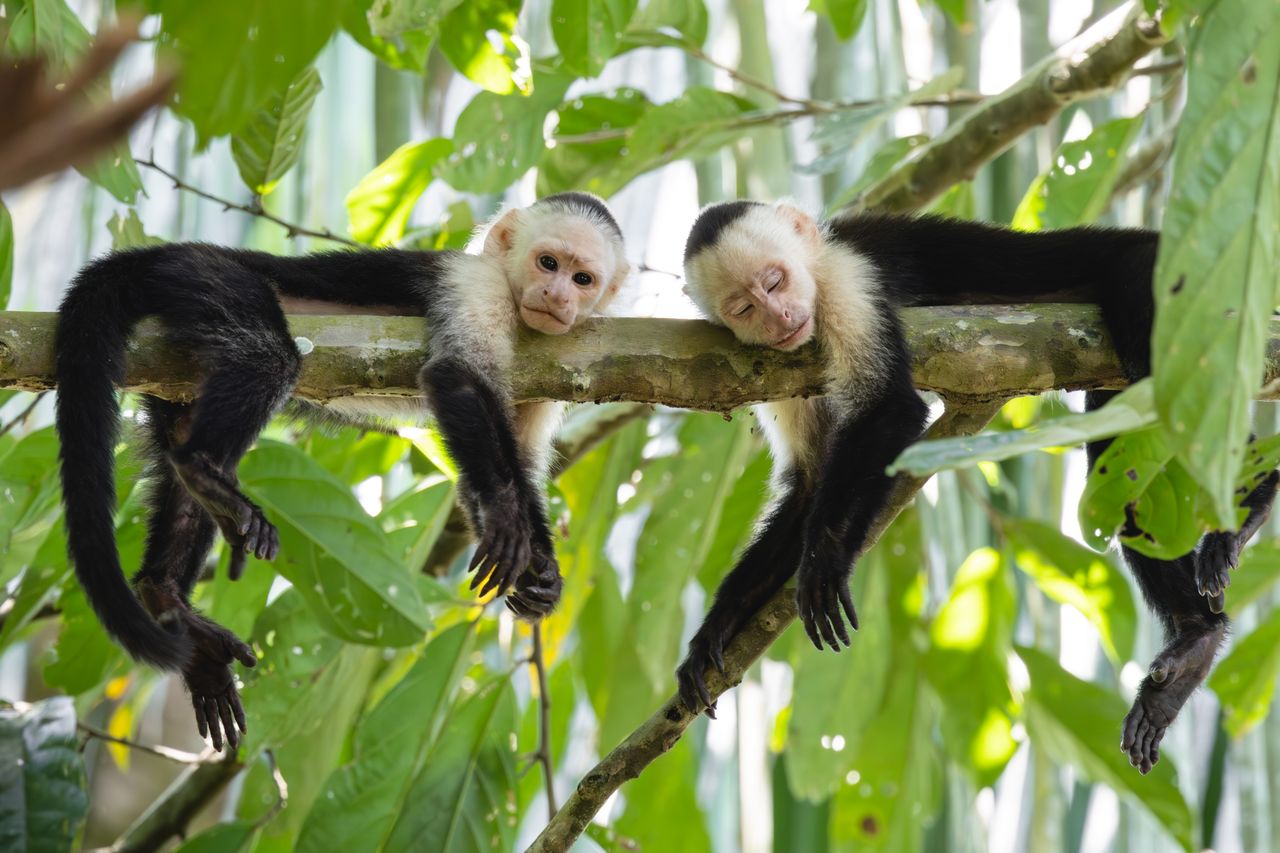
The Central Pacific is where many first-time visitors fall in love with Costa Rica. Manuel Antonio National Park combines rainforest trails with white-sand coves, and sloths, capuchin monkeys and squirrel monkeys are often seen within minutes. Nearby, Jacó is a busy surf town close to San José, and Carara National Park is a reliable place for scarlet macaws.
Best for: first-timers, families, and anyone who wants wildlife and beach time in one place.
Highlights: Manuel Antonio National Park, mangrove kayaking, catamaran trips, the crocodiles of the Tárcoles River, and the scarlet macaws of Carara.
Getting there: Manuel Antonio is roughly a three-hour drive from San José, and Jacó is closer.
Good to know: Manuel Antonio is one of the most visited parks in the country. Arrive at opening time and check which day of the week the park is closed before you plan.
Maybe not for you if: you want remote, crowd-free nature. The area is beautiful but popular.
South Pacific (Costa Ballena)
South of Manuel Antonio, the coast becomes quieter and wilder. The stretch from Dominical to Uvita and Ojochal, known as Costa Ballena, or the Whale Coast, is home to Marino Ballena National Park and its famous sandbar shaped like a whale’s tail.
Best for: whale watching, relaxed beaches, waterfalls and a slower pace than the Central Pacific.
Highlights: humpback whale tours, the whale-tail sandbar at low tide, Nauyaca Waterfalls, surfing in Dominical, and the small restaurants of Ojochal.
Weather and timing: humpback whales visit from about July to October and December to March.
Maybe not for you if: you want big resorts. Accommodation here tends to be boutique hotels and villas in the hills.
Osa Peninsula
The Osa Peninsula is Costa Rica at its wildest. Corcovado National Park protects one of the largest remaining areas of lowland rainforest on the Pacific coast of Central America, and it is famous for its density of wildlife, including tapirs, all four of Costa Rica’s monkey species and scarlet macaws.
Best for: serious wildlife lovers, nature photographers and adventurous couples.
Highlights: guided hikes in Corcovado, snorkeling and diving at Caño Island, dolphin and whale watching, and the calm waters of the Golfo Dulce.
Getting there: most visitors fly from San José to Drake Bay or Puerto Jiménez, or drive to Sierpe and take a boat to Drake Bay. Travel takes effort, which is part of what keeps the region so wild.
Good to know: Corcovado requires entry permits and a certified guide, so plan visits in advance.
Maybe not for you if: you want nightlife, quick transfers or a short trip. The Osa deserves at least three or four nights.
Arenal and the Northern Plains
Arenal Volcano rises in a near-perfect cone above the town of La Fortuna, and the region around it is Costa Rica’s adventure hub. Hot springs fed by volcanic heat, waterfalls, hanging bridges, ziplines and rafting are all close together, which makes Arenal one of the easiest regions to enjoy.
Best for: first-timers, active travelers, families with older kids, and couples who want adventure followed by a hot spring soak.
Highlights: La Fortuna Waterfall, Arenal Volcano National Park, hot springs, hanging bridges, ziplining, Lake Arenal, and day trips to the blue water of Río Celeste in Tenorio Volcano National Park.
Getting there: about three hours from San José and a similar drive from Liberia.
Weather: Arenal sits on the wetter Caribbean slope of the mountains, so rain is possible in any month, and the volcano’s summit is often in the clouds. Early mornings usually give the clearest views.
Maybe not for you if: you want a beach. Arenal pairs well with a coastal region instead.
Monteverde
Monteverde sits high in the mountains, where clouds drift through the forest and trees are draped in mosses, orchids and ferns. The town of Santa Elena and the surrounding reserves were shaped in part by Quaker settlers who arrived in the 1950s and helped protect the forest.
Best for: nature lovers, birdwatchers, families, and anyone who enjoys cool weather after the heat of the coast.
Highlights: the Monteverde and Santa Elena cloud forest reserves, hanging bridges, some of Costa Rica’s longest ziplines, hummingbird gardens, coffee and chocolate tours, and guided night walks.
Getting there: Monteverde is reached by mountain roads from the Pacific side. Travelers heading to or from Arenal often use the jeep-boat-jeep transfer across Lake Arenal.
Good to know: it can be cool, windy and damp, so pack a warm layer and a rain jacket.
Maybe not for you if: you dislike winding mountain roads or cool, misty weather.
Tortuguero (North Caribbean)
Tortuguero is a village on a strip of land between canals and the Caribbean Sea, with no roads in or out. Everything moves by boat, and the canals are lined with rainforest where caimans, monkeys, sloths and toucans are a daily sight. The beach is one of the most important green turtle nesting sites in the Western Hemisphere.
Best for: turtle season trips, boat-based wildlife viewing and travelers who want a unique, off-grid feel.
Highlights: guided canal tours by boat or kayak, turtle nesting tours with licensed guides (roughly July to October for green turtles), and the Afro-Caribbean village itself.
Getting there: by road and then boat from San José, or by small plane.
Maybe not for you if: you want a swimming beach. Tortuguero’s beach has strong currents and is not for swimming.
South Caribbean
The southern Caribbean coast moves to its own rhythm. Towns such as Cahuita, Puerto Viejo and Manzanillo blend Afro-Caribbean culture, reggae and calypso, and rainforest that runs right down to the sand. The food is a highlight, including rice and beans cooked in coconut milk and spicy rondón stew.
Best for: food lovers, culture seekers, relaxed beach days and travelers who want a different side of Costa Rica.
Highlights: snorkeling and sloth spotting in Cahuita National Park, the beaches between Puerto Viejo and Manzanillo, the Gandoca-Manzanillo Wildlife Refuge, chocolate tours, cycling between beaches, and visits to Indigenous Bribri communities.
Getting there: about four hours by road from San José.
Weather: the Caribbean follows a different weather pattern from the Pacific. September and October, the wettest months on the Pacific side, are often among the driest and sunniest here.
Maybe not for you if: you want large resorts. Accommodation is mostly small hotels, cabins and boutique lodges.
Central Valley and San José
Most trips begin and end in the Central Valley, where San José and the international airport sit among mountains and coffee farms. The climate is mild and spring-like all year, and the area is easy to explore on day trips.
Best for: culture, coffee lovers, a night before or after flights, and short side trips.
Highlights: the National Theatre and the Pre-Columbian Gold and Jade museums in San José, coffee farm tours, Poás and Irazú volcanoes, and white-water rafting on the Pacuare River near Turrialba.
Maybe not for you if: you want nature and beaches. Most travelers spend one night here, then move on.
Southern Highlands
The Southern Highlands rise along the Talamanca Mountains, home to Cerro Chirripó, the highest peak in Costa Rica. The air is cool, the rivers are clear, and the valleys are home to some of the best birdwatching in the country.
Best for: birders, hikers and travelers who want a cool, quiet mountain stay.
Highlights: resplendent quetzals in San Gerardo de Dota and Los Quetzales National Park, trout fishing, hiking, and the multi-day climb of Chirripó.
Good to know: nights can be cold, so pack warm clothes.
Best Region for Every Type of Traveler
| If you are… | Best regions | Why |
|---|---|---|
| A first-time visitor | Arenal, Monteverde and the Central Pacific | The classic route: volcano, cloud forest and beach with wildlife |
| A family with young kids | Guanacaste, Arenal, Manuel Antonio | Short transfers, easy wildlife and calm beaches |
| A family with teens | Arenal, Monteverde, Osa Peninsula | Ziplining, rafting, night walks and real adventure |
| A honeymoon couple | Papagayo (Guanacaste), Osa Peninsula, Nosara | Secluded resorts, eco-lodges and sunsets |
| A wildlife lover | Osa Peninsula, Tortuguero, Monteverde | The highest density and variety of animals |
| A surfer | Nicoya Peninsula, Tamarindo, Dominical, Puerto Viejo | Consistent waves for every level |
| An adventure seeker | Arenal, Monteverde, Turrialba | Ziplines, rafting, canyoning and hiking |
| A wellness traveler | Nosara, Santa Teresa, Arenal hot springs | Yoga retreats, healthy food and thermal pools |
| A foodie or culture lover | South Caribbean, Central Valley, Guanacaste | Caribbean cooking, coffee culture and sabanero traditions |
| A birdwatcher | Southern Highlands, Monteverde, Sarapiquí | Quetzals, hummingbirds and hundreds of species |
| Short on time | Guanacaste (via Liberia) or Central Pacific (via San José) | Close to an international airport |
| Looking to unplug | Osa Peninsula, Tortuguero | Remote lodges, few roads and lots of nature |
Pacific Side vs. Caribbean Side
| Pacific side | Caribbean side | |
|---|---|---|
| Regions | Guanacaste, Nicoya, Central and South Pacific, Osa | Tortuguero, South Caribbean |
| Driest months | December to April | Often September and October, and again around February and March |
| Beaches | Many swimmable beaches, surf breaks and sunsets over the ocean | Fewer but beautiful beaches backed by rainforest, sunrise views |
| Culture | Spanish-speaking, Costa Rican and sabanero traditions | Afro-Caribbean heritage, English Creole, reggae and calypso |
| Accommodation | From large resorts to boutique hotels | Mostly small hotels, cabins and eco-lodges |
| Wildlife | Scarlet macaws, squirrel monkeys, whales | Sea turtles, toucans, sloths, poison dart frogs |
Neither side is better; they are simply different. Many travelers visit both, or pair one coast with Arenal or Monteverde.
Which Region to Visit by Season
Costa Rica has two main seasons, but they don’t behave the same way everywhere.
| Season | When | Where it shines |
|---|---|---|
| Dry season | December to April | Guanacaste, Nicoya and the Central and South Pacific are at their sunniest |
| Early green season | May to August | The Pacific is lush and quieter, with rain mostly in the afternoons; turtle season begins in Tortuguero |
| Wettest Pacific months | September and October | The Caribbean coast is often at its driest; Tortuguero turtle nesting continues |
| Transition | November | Rains ease on the Pacific; forests are green and crowds are light |
Inland regions such as Arenal and Monteverde can see rain in any month, so pack a light rain jacket year-round.
How Many Regions Should You Visit?
A good rule of thumb is to allow at least three nights in each region, plus travel days. Driving distances look short on a map, but mountain roads mean most transfers between regions take three to five hours.
- One week: choose two regions, such as Arenal and Guanacaste, or Arenal and Manuel Antonio.
- Ten days: choose three regions, such as Arenal, Monteverde and Manuel Antonio, or Arenal, the Nicoya Peninsula and Guanacaste.
- Two weeks: choose three or four regions, such as Tortuguero, Arenal, Monteverde and Manuel Antonio, or Arenal, Monteverde and the Osa Peninsula.
Getting Around Between Regions
How you travel between regions shapes how many you can comfortably fit in.
- Rental car: the most flexible option. A 4×4 is a good idea for the Nicoya Peninsula, the Osa Peninsula and some routes to Monteverde, where roads can be steep, unpaved or crossed by small rivers in the rainy season. Avoid driving after dark on unfamiliar mountain roads.
- Private driver: a relaxing choice for families and anyone who would rather enjoy the scenery than navigate. Drivers often stop at viewpoints, fruit stands and local restaurants along the way.
- Shared shuttles: tourist shuttles run between the most popular regions, such as San José, Arenal, Monteverde, Manuel Antonio and Guanacaste, with hotel pickups.
- Domestic flights: small planes connect San José with Drake Bay, Puerto Jiménez, Tortuguero, Quepos, Tamarindo and other towns, turning a long drive into a short flight. Luggage limits on these flights are strict, so pack light.
- Boats: Tortuguero is reached by boat or small plane, and Drake Bay is often reached by boat from Sierpe. Lake Arenal crossings link Arenal and Monteverde.
- Public buses: inexpensive and widely used by locals, but slower and best suited to flexible travelers with light luggage.
Whatever you choose, plan most transfers for the morning, when roads are quieter and afternoon rain hasn’t arrived yet.
Sample Routes by Travel Style
- Classic first trip: San José, then Arenal, Monteverde and Manuel Antonio. It covers volcano, cloud forest and beach with wildlife.
- Easy beach and adventure: fly into Liberia, spend time in Arenal, then finish on a Guanacaste beach.
- Coast to coast: Tortuguero or the South Caribbean, then Arenal, then the Central or South Pacific.
- Deep nature: Monteverde, then the South Pacific, then the Osa Peninsula.
- Surf and wellness: Nosara or Santa Teresa, with a few days in Arenal for hot springs and hiking.
Tips for Choosing Your Costa Rica Region
- Start with your non-negotiable. If reliable sun matters most, think Guanacaste in the dry season. If wildlife matters most, think Osa or Tortuguero.
- Choose your airport wisely. Liberia (LIR) is closest to Guanacaste and Nicoya. San José (SJO) is better for the Central Pacific, the Caribbean and the south.
- Don’t try to see everything. Fewer regions with longer stays means less time in the car and more time enjoying each place.
- Balance the pace. Pair an active region, such as Arenal, with a relaxing one, such as a beach.
- Think about the weather on both coasts. If you are traveling in September or October, the Caribbean side is often the better beach choice.
Frequently Asked Questions About Costa Rica’s Regions
What are the main regions of Costa Rica?
For travelers, Costa Rica is usually divided into Guanacaste, the Nicoya Peninsula, the Central Pacific, the South Pacific, the Osa Peninsula, Arenal and the Northern Plains, Monteverde, Tortuguero on the North Caribbean coast, the South Caribbean, the Central Valley around San José, and the Southern Highlands.
What are the provinces of Costa Rica?
Costa Rica has seven provinces: San José, Alajuela, Cartago, Heredia, Guanacaste, Puntarenas and Limón. Travel regions often cross province lines, so most travel guides, including this one, use regions instead.
What is the best region of Costa Rica for first-time visitors?
Most first-time visitors enjoy combining Arenal, Monteverde and the Central Pacific around Manuel Antonio. Together they cover a volcano, cloud forest, rainforest wildlife and beaches. With less time, Arenal plus one beach region works well.
Which side of Costa Rica is better, Pacific or Caribbean?
Neither is better; they are different. The Pacific side has more beaches and resorts and is driest from December to April. The Caribbean side has Afro-Caribbean culture, rainforest and a more laid-back feel, and it is often driest in September and October.
What is the best area to stay in Costa Rica?
It depends on your travel style. Guanacaste is best for sunny beaches and resorts, Arenal for adventure and hot springs, Manuel Antonio for wildlife and beach together, the Osa Peninsula for wild nature, and the South Caribbean for culture and a slower pace.
What is the best region of Costa Rica for families?
Guanacaste, Arenal and Manuel Antonio are the easiest for families with young children because of short transfers, calm beaches and easy wildlife viewing. Families with teens often add Monteverde for ziplining and night walks.
How many regions of Costa Rica can you visit in one week?
Two regions is ideal for one week, such as Arenal and Guanacaste, or Arenal and Manuel Antonio. Most transfers between regions take three to five hours, so allowing at least three nights in each place keeps the trip relaxed.
Should I fly into San José or Liberia?
Fly into Liberia (LIR) if you plan to focus on Guanacaste, the northern Nicoya Peninsula or Arenal. Fly into San José (SJO) for the Central and South Pacific, the Caribbean coast, the Osa Peninsula and the Southern Highlands.
Which region of Costa Rica is best in the rainy season?
In September and October, the wettest months on the Pacific side, the southern Caribbean coast and Tortuguero are often drier and sunnier. Earlier in the green season, from May to August, the Pacific coast is lush, quieter and usually rainy only in the afternoons.
Final Thoughts
There is no single best region of Costa Rica, only the region that best matches the way you like to travel. Sun seekers will love Guanacaste and Nicoya, adventurers will thrive in Arenal and Monteverde, nature lovers will find their happy place in the Osa Peninsula and Tortuguero, and anyone drawn to culture and a slower pace will feel at home on the southern Caribbean coast. Choose two or three regions that fit you, give each one enough time, and you will see why so many travelers come back to Costa Rica again and again.